Light pollution is the dominant constraint on visual astronomy for most observers in Poland. Warsaw, Kraków, Wrocław and Tricity (Gdańsk-Gdynia-Sopot) generate significant sky glow that suppresses faint object visibility across a radius of 50–100 km. But proximity to light pollution does not make astronomy impossible — it shifts the type of observing that is practical from any given location.
This article covers the Bortle scale used to classify sky darkness, the realistic target selection for observers at each level, dark-sky sites accessible from major Polish cities, and the filter types that partially compensate for artificial sky glow.
The Bortle scale
Developed by amateur astronomer John Bortle in 2001, the Bortle Dark-Sky Scale rates observing sites from 1 (the darkest possible) to 9 (inner-city skies). The scale uses naked-eye visibility of specific sky features as its calibration points — no equipment needed to estimate your local Bortle class.
- Bortle 1: True dark sky. Zodiacal light, gegenschein and zodiacal band all visible. M33 (Triangulum Galaxy) visible directly, not only averted. Practically no such sites exist within reasonable distance of any Polish city.
- Bortle 2–3: Rural sky. Milky Way shows complex structure, M33 visible with averted vision, limiting magnitude 6.5+. Accessible in the Bieszczady mountains, parts of Podlasie and some areas of Mazury during clear, moonless nights.
- Bortle 4–5: Rural-suburban transition. Milky Way visible but washed out near the horizon. M31 is obvious. Limiting magnitude around 5.5–6.0. Many sites 60–80 km from medium-sized Polish cities fall here.
- Bortle 6–7: Suburban sky. Milky Way visible only near zenith under best conditions. M31 and Praesepe (M44) just visible naked eye. Limiting magnitude 5.0–5.5. This covers the outskirts of Warsaw, Kraków, Wrocław under typical conditions.
- Bortle 8: City sky. Milky Way invisible. Brighter Messier objects detectable only with optical aid. Limiting magnitude 4.5. Typical for inner suburbs.
- Bortle 9: Inner city. Only a few hundred stars visible. Limiting magnitude 4.0 or less. Moon-influenced sky brightness much of the time. Deep-sky work essentially impossible.
The Light Pollution Map overlays VIIRS satellite data on a geographic map and is the most widely used tool for locating your current Bortle class and identifying darker sites within driving distance.
What is observable at each Bortle level
From a Bortle 7–8 location (city/inner suburb)
The Moon is always a productive target regardless of sky brightness. All crater detail visible in a modest telescope is accessible from any urban balcony — sky background brightness does not affect lunar contrast. The planets — Jupiter, Saturn, Mars, Venus — are similarly unaffected by light pollution in terms of surface/ring detail. Double stars, whose resolution depends on aperture and atmospheric steadiness rather than sky background, are also fully available from city locations.
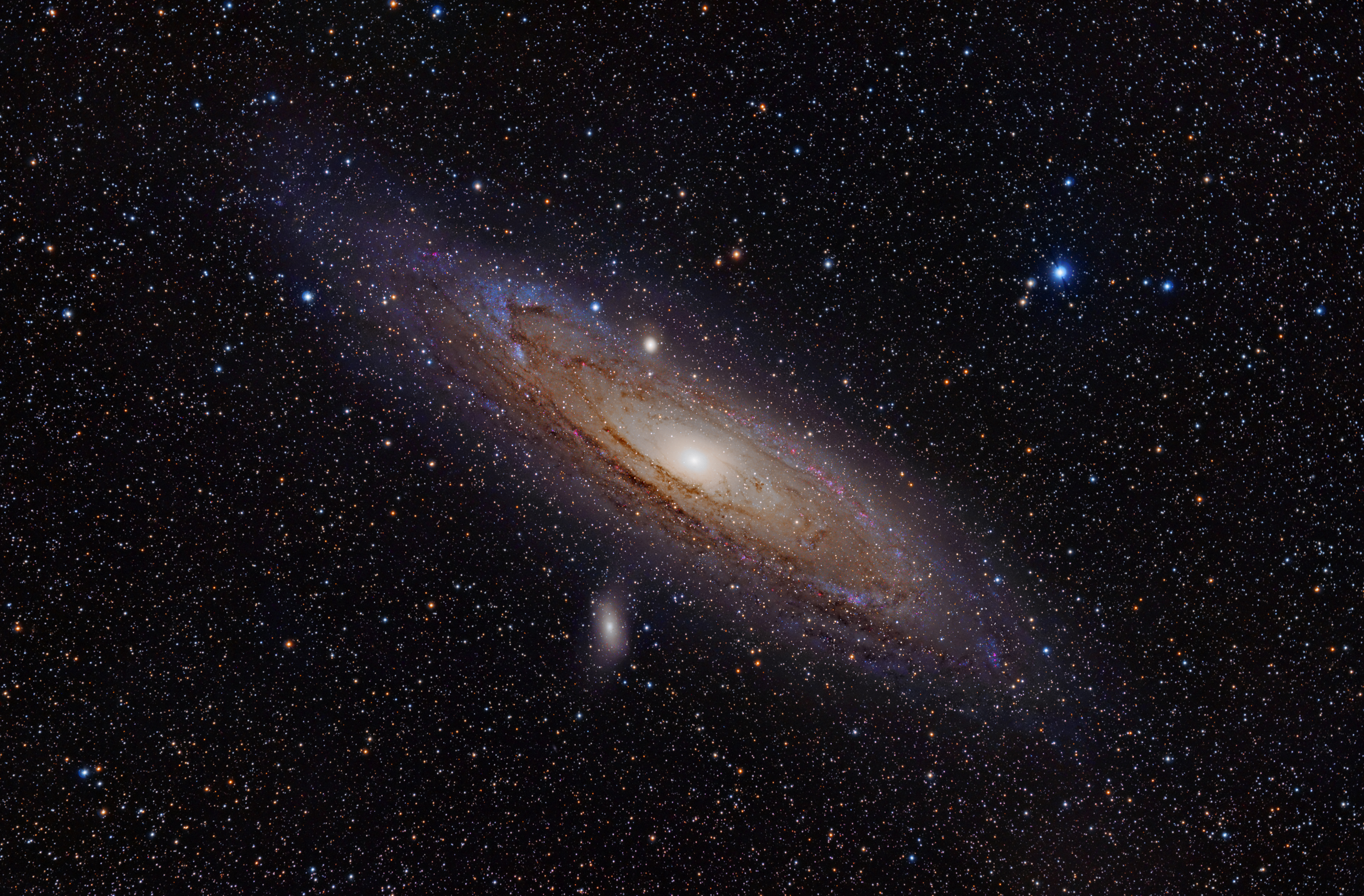
The brighter Messier objects are detectable but degraded. M42 (Orion Nebula), M45 (Pleiades), M31 (Andromeda), M13 (Hercules Cluster) are all findable but appear smaller and less structured than under darker skies. Globular clusters hold up better than nebulae under poor skies.
From a Bortle 5–6 location (outer suburb)
The full Messier catalogue becomes accessible to a 150 mm telescope, though faint reflection nebulae and low-surface-brightness galaxies remain difficult. The Summer Milky Way provides a usable background for wide-field binocular sweeps. Dark nebulae — regions where interstellar dust blocks background stars — become intermittently visible in rich starfields.
From a Bortle 3–4 location (rural)
The difference between Bortle 4 and Bortle 7 is substantial. An eyepiece delivering 7× magnification through 50 mm binoculars reveals dozens of objects per session that were simply invisible from suburban locations. Large nebulae such as the North America Nebula (NGC 7000) and the Veil Nebula Complex become accessible to the naked eye or wide-field binoculars. The NGC catalogue starts to open up seriously at this level with a 200 mm telescope.
Accessible dark-sky locations from major Polish cities
From Warsaw
The Kampinos National Park (Kampinoski Park Narodowy), approximately 30 km west of the city centre, offers the closest accessible dark sky — typically Bortle 5 within the park's interior. Driving east toward Mazury adds another level of darkness by the time you pass Siedlce. The Roztocze region (south-east of Lublin, 200 km from Warsaw) reaches Bortle 3 on moonless nights and is a realistic overnight-trip destination.
From Kraków
The Beskid mountains begin within 40–50 km of the city. Passes above 800 m altitude in the Beskid Wyspowy or Gorce ranges typically reach Bortle 4–5. The Bieszczady region (180 km south-east) contains some of the darkest skies in mainland Poland at Bortle 2–3 and is the destination most frequently cited by Polish observers for serious deep-sky work.
From Wrocław
The Karkonosze mountains, roughly 100 km south, offer Bortle 4 skies accessible by car in under two hours. The ridge between Szklarska Poręba and Karpacz, when conditions allow a clear southern horizon, shows the Milky Way core structure in summer with good transparency.
From Tricity (Gdańsk)
The Tucholskie Forests (Bory Tucholskie, 60–90 km south-west) reach Bortle 4 and are a common destination for Pomeranian observers. The flat terrain and low tree lines at selected clearings allow a low horizon in all directions.
Light-pollution filters
Narrowband filters suppress wavelengths most associated with artificial light: sodium vapour (589 nm) and mercury vapour (436 nm, 546 nm) lamps. They transmit primarily in hydrogen-alpha (656 nm), hydrogen-beta (486 nm) and oxygen III (496 nm, 501 nm) wavelengths — the emission lines of common astronomical nebulae.
UHC (Ultra High Contrast) filters
A UHC filter is the most versatile choice for visual observation under light-polluted skies. It noticeably improves contrast on emission nebulae — M42, M17, M8, NGC 2024 — without drastically reducing star brightness. It is less effective on reflection nebulae and open star clusters where wavelength selectivity is not helpful.
OIII filters
An oxygen III filter is narrower than UHC and provides the highest contrast on planetary nebulae (M57 Ring Nebula, M27 Dumbbell Nebula) and the Veil Nebula complex. It suppresses stars strongly, which can make star-hopping to faint targets more difficult. Best suited to a targeted session on specific emission objects rather than general browsing.
Broadband light-pollution filters (CLS, LPR)
City Light Suppression (CLS) and Light Pollution Reduction (LPR) filters block the most common lamp emission lines while passing a broader wavelength range than UHC or OIII filters. They provide a modest improvement on extended objects from Bortle 7–8 skies and are more useful for astrophotography than for visual observation.
What filters cannot do
No filter improves visibility of reflection nebulae — blue scattered light from embedded stars falls in the same wavelength range as the artificial sky glow that the filters are designed to suppress. Galaxies also respond poorly to narrowband filters, because their surface brightness across the optical spectrum is too broad to benefit from wavelength selectivity. For those targets, darker skies are the only solution.
Dark adaptation and local observing practices
Full dark adaptation requires 20–30 minutes with no exposure to white light. Even a brief glance at a phone screen set to minimum brightness resets the process. Using a red-filtered torch preserves adaptation effectively — red light at wavelengths above 620 nm has minimal effect on the rod cells responsible for low-light vision. Several inexpensive headlamp models offer a dedicated red LED mode.
Polish summer nights present a specific constraint: astronomical twilight does not end until around 23:00–23:30 at 52°N near the summer solstice. In mid-June, astronomical darkness between sunset and sunrise narrows to less than three hours in Warsaw. Planning sessions around the May–June window before solstice, or the August–September window after it, gives three to four hours of full darkness from around 22:00 onward.
Further reference
The International Dark-Sky Association maintains a database of certified dark-sky parks and reserves worldwide, including several in Central Europe. LightPollutionMap.info offers current satellite-based sky brightness data overlaid on an interactive map for planning site visits across Poland.