The single most common mistake among first-time telescope buyers is focusing on magnification numbers printed on the box. A 525× figure sounds impressive, but it is essentially meaningless without adequate aperture to back it up. The image you actually see at the eyepiece is determined primarily by the diameter of the objective lens or mirror — not the maximum magnification the manufacturer claims.
This guide covers the three main telescope designs available to beginners, the mount types you will encounter, and the practical considerations specific to observers in Poland — including storage, transport to darker sites, and the effect of Polish winter temperatures on optics and observer comfort.
The three main optical designs
Refractors
A refractor uses a glass lens at the front of the tube to gather and focus light. The design is sealed, which keeps dust and moisture out — a genuine advantage in Polish autumn and spring conditions. Entry-level refractors in the 60–80 mm aperture range are affordable and robust, making them a reasonable first instrument for visual work on the Moon and bright planets.
The trade-off is cost per aperture. A quality 100 mm refractor costs considerably more than a 150 mm reflector of equivalent optical quality. Chromatic aberration — a coloured fringe around bright objects — is present in cheaper achromatic designs. Apochromatic refractors correct this but carry a significant price premium.
Practical use: refractors require little to no maintenance, cool down quickly due to their shorter tubes, and are straightforward to transport to observing sites. For Moon and planetary work from a balcony in Warsaw or Kraków, an 80 mm achromat on a stable alt-azimuth mount is a sensible starting point.
Newtonian reflectors
A Newtonian uses a parabolic primary mirror to collect light, which is reflected to a secondary mirror and then to an eyepiece mounted at the side of the tube near the front. The design delivers the most aperture per zloty across most price brackets, which is why it remains the most popular choice among beginners worldwide.
A 150 mm (6-inch) Newtonian on a simple equatorial mount can show the cloud bands of Jupiter, the rings of Saturn at decent resolution, and a range of Messier objects on nights with reasonable transparency. This combination is available from Polish and European retailers in the 800–1500 PLN range as of 2026.
The design requires periodic mirror alignment — a process called collimation — that takes around five minutes once you have done it a few times. Mirrors also accumulate dust over time and may need recoating after a decade of use, though this is not an immediate concern for a new buyer.
Compound designs: SCT and Mak-Cas
Schmidt-Cassegrain (SCT) and Maksutov-Cassegrain (Mak-Cas) telescopes fold a long focal length into a compact tube by bouncing light between a primary and secondary mirror inside a sealed tube. A Mak-Cas with a 127 mm aperture and a focal length of 1500 mm fits easily into a backpack, which matters when driving to observing sites in the Bieszczady or Karkonosze mountains.
The compactness comes with a longer cool-down time. A 150 mm Mak-Cas can take 45–60 minutes to reach ambient temperature on a cold Polish winter night before images stabilise. This is a real scheduling constraint for observers who arrive at a dark site and want to begin immediately.
For observers primarily interested in the Moon and planets — rather than wide-field deep-sky objects — a Mak-Cas is worth the trade-off. For wide-field views of nebulae and star clusters, a Newtonian or short-focal-length refractor is more effective.
Mount types and why they matter
Alt-azimuth mounts
An alt-azimuth (alt-az) mount moves on two axes: up-down (altitude) and left-right (azimuth). It is simple and intuitive — point it at an object and it stays there. The Dobsonian is the most common alt-az design for reflectors: a rocker box on a lazy-susan base that supports a large Newtonian tube. An 8-inch (200 mm) Dobsonian typically costs less than a 6-inch Newtonian on a comparable equatorial mount, and it shows more of the sky for the same budget.
The limitation for visual planetary work is that stars trail across the field of view as Earth rotates, requiring frequent manual nudging. For an observer learning the sky by hand, this is not a problem — the tracking demand actually reinforces familiarity with stellar motion.
Equatorial mounts
An equatorial (EQ) mount has one axis aligned with Earth's rotational axis. Once polar-aligned, a slow turn on the right ascension axis keeps an object centred. This is essential for astrophotography with any exposure longer than a few seconds, and it makes sustained planetary observation more comfortable during high-magnification sessions.
Polar alignment in Poland requires pointing the mount's polar axis toward Polaris (the North Star), which sits at roughly 52–54 degrees altitude depending on your latitude. Most entry-level equatorial mounts include a polar-alignment scope that makes this straightforward once you understand the procedure.
GoTo mounts
GoTo computerised mounts point automatically at thousands of catalogued objects after a brief alignment routine. They are genuinely useful for locating faint deep-sky objects in light-polluted conditions where star-hopping is difficult. The trade-off is cost and complexity: a motorised GoTo mount adds substantially to the total price, and the alignment procedure adds 10–15 minutes at the start of each session.
For a first telescope, a GoTo mount is not necessary. Learning to navigate by eye builds spatial awareness of the sky that GoTo cannot substitute.
Aperture guidelines by target type
- Moon and planetary detail: 70 mm minimum, 100 mm+ recommended for Saturn's Cassini Division and Jupiter's Great Red Spot under steady seeing.
- Bright nebulae and star clusters: 100–150 mm sufficient for Messier objects; 200 mm+ opens up the NGC catalogue meaningfully.
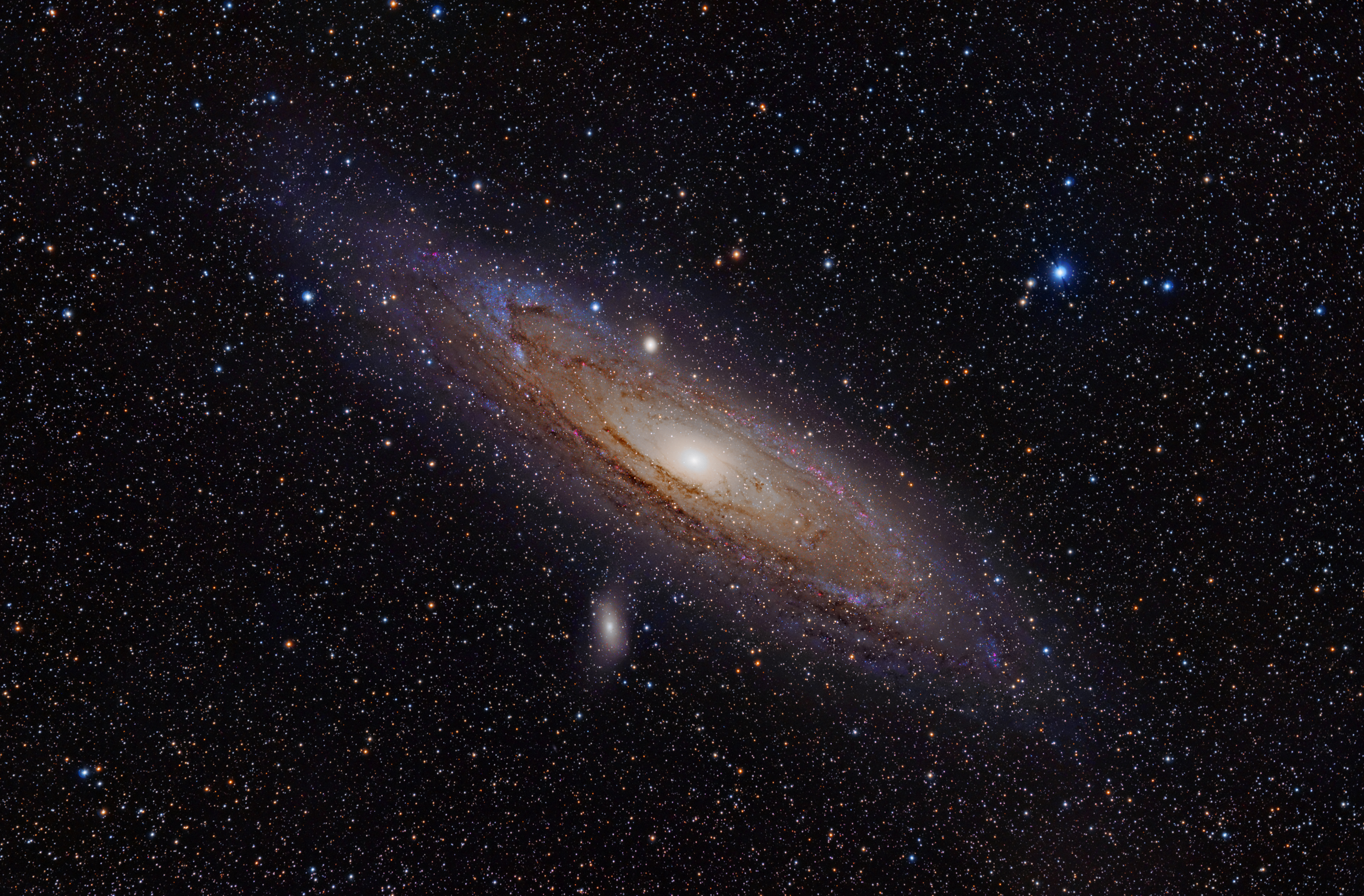
- Galaxies beyond M31 and M33: 150–200 mm necessary to see structure rather than just a faint smudge. Light pollution matters as much as aperture for these targets.
- Double stars: Even a 60 mm refractor splits hundreds of pairs; this is the most accessible target category for urban balcony observers.
Practical considerations for Poland
Temperature swings between Polish summer and winter nights are significant — from +25°C in July to −15°C in January in some regions. Metal tube telescopes contract in cold weather; mirrors and lenses may fog when brought indoors after a cold session. Leaving optics to acclimatise before storing them prevents moisture damage.
Transport is a regular consideration for observers outside major cities. A 200 mm Dobsonian fits in most car boots but is unwieldy on public transport. If you rely on trains to reach dark-sky sites in the Beskid mountains or along the Vistula river valley, a compact Mak-Cas or short-tube refractor is significantly more practical.
Several astronomy clubs in Poland — including PTM (Polskie Towarzystwo Miłośników Astronomii) — organise joint observing sessions at dark sites. Attending a club night before purchasing lets you try different instrument types under real conditions, which is the most reliable way to identify the right tool for your observing habits.
Further reference
The Cloudy Nights forum maintains detailed buyer’s guides for each telescope category. PTMA (Polskie Towarzystwo Miłośników Astronomii) lists regional clubs and observing events across Poland.